How To Have The Conversation
A lot of big guys avoid the doctor before they start lifting, because the last visit turned into a lecture about weight instead of a conversation about training. Here's how to walk in prepared, get an answer you can actually use, and push back when "lose weight first" isn't one.
Why the visit is worth having anyway
You do not need medical permission to start strength training. For the large majority of people, the risk of a supervised, gradually progressed lifting programme is low, and the risk of staying sedentary is well documented and considerably higher. Current screening guidance from the American College of Sports Medicine actually moved in this direction: most adults, including those with existing risk factors, no longer need medical clearance before starting light-to-moderate exercise, and clearance is reserved for people with specific red-flag symptoms or diagnosed cardiovascular, metabolic or renal disease planning vigorous exercise.
Riebe D, Franklin BA, Thompson PD, et al. Updating ACSM's Recommendations for Exercise Preparticipation Health Screening. Med Sci Sports Exerc. 2015;47(11):2473–2479. Read 10 September 2026.
So the visit is not usually a gatekeeping step. It is worth doing anyway, because a doctor who knows you are about to start lifting heavy can flag anything specific to your own health — blood pressure, joint history, medication — before it becomes a problem mid-programme, rather than after.
What to actually ask
Walk in with a short, specific list rather than an open-ended "is it okay if I exercise." Specific questions get specific answers:
- "I'm planning to start structured strength training two to three times a week, working up gradually. Is there anything in my history that changes how I should approach that?"
- "Are any of my current medications affected by heavy resistance exercise, breath-holding during a lift, or sudden blood pressure changes?"
- "Is there a joint or old injury you'd want me to get imaged or assessed before I load it heavily?"
- "Can I get a baseline blood pressure and, if relevant, bloodwork, so we have a number to compare against later?"
That last one is worth doing even if nothing else changes. A number taken today is the only way to tell, six months from now, whether training is moving things in the direction you want.
What a blood pressure reading actually means here
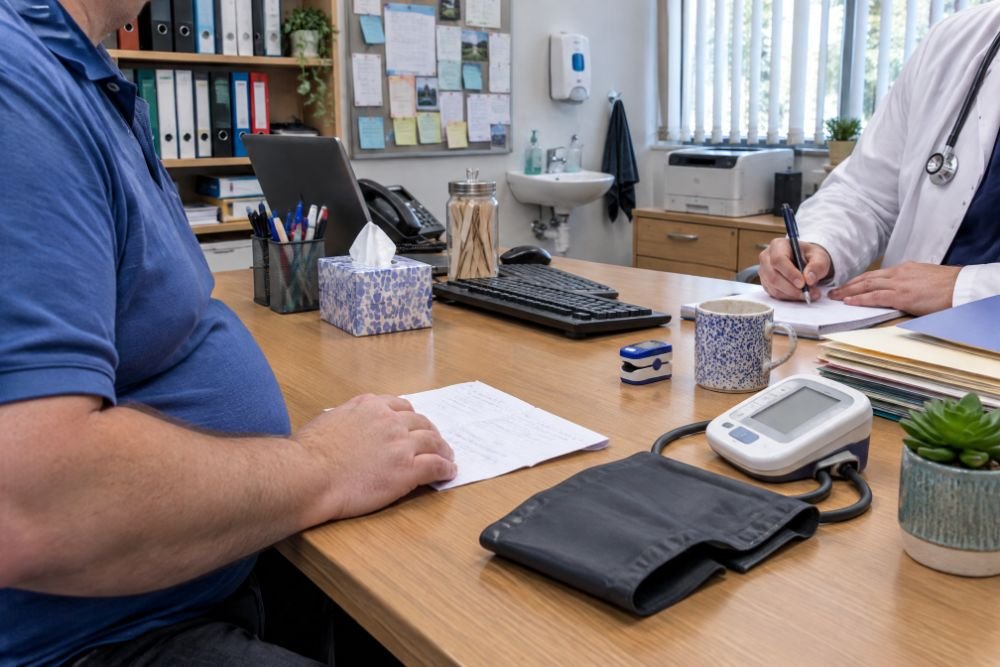
Blood pressure cuffs come in sizes, and the cuff has to match your arm for the number to mean anything. A cuff that is too small for the arm it's wrapped around reads artificially high — sometimes by a meaningful margin — which is a measurement problem, not a health one. It is a real and common source of error in general practice, not a rare edge case.
Muntner P, Shimbo D, Carey RM, et al. Measurement of Blood Pressure in Humans: A Scientific Statement From the American Heart Association. Hypertension. 2019;73:e35–e66. Read 10 September 2026.
It is a completely reasonable question to ask directly: "is this the large or extra-large cuff?" A clinic that does not stock a properly sized cuff for your arm is not measuring your blood pressure accurately, and a number from an ill-fitting cuff is not a reason to change anything about your training. If a reading does come back genuinely elevated on a correctly sized cuff, that is useful information — it means checking in with bracing technique and breath control once you're lifting heavy, a topic worth its own conversation with a trainer or physio, not a reason to avoid the gym.
Medications worth naming out loud
Do not assume your doctor has automatically connected your prescription list to "heavy resistance training" unless you say the words. A few classes of medication are worth naming specifically, because the interaction is not always obvious from a routine chart review:
- Blood pressure medication — beta blockers and some other classes blunt the heart-rate response to exertion, which changes how "hard" a set feels relative to your actual effort. Ask whether that changes how you should judge intensity.
- Diuretics. These change your fluid and electrolyte balance, which matters for a training session where you are sweating heavily and bracing hard under load.
- Blood thinners. Worth flagging before you start anything involving a real fall risk, and worth knowing about if you bruise more easily than expected from normal training contact.
- Diabetes medication, insulin in particular. Exercise changes how your body uses glucose, sometimes for hours afterward, and that is a conversation your prescribing doctor should be part of rather than something you work out by trial and error.
None of these are reasons to avoid training. They are reasons to have one specific conversation before you start, rather than finding out about an interaction the hard way three weeks in.
Pushing back on "lose weight first"
Weight bias among healthcare providers is well documented, not a matter of perception. A widely cited review found that clinicians across specialties have reported viewing higher-weight patients less favourably than other patients, associating them with poor discipline and non-compliance independent of the actual clinical picture in front of them, and that this bias measurably affects communication, time spent, and the quality of care offered.
Puhl RM, Heuer CA. The Stigma of Obesity: A Review and Update. Obesity (Silver Spring). 2009;17(5):941–964. Read 10 September 2026.
That means "lose weight first" is sometimes a genuinely relevant clinical instruction and sometimes a reflex answer standing in for an actual assessment. The way to tell the difference, and to get past it either way, is to ask the visit to be specific: "I understand that's a general recommendation. For the specific thing I came in about — starting a lifting programme — is there a concrete reason I need to wait, or a specific test you'd want first?" A doctor with an actual clinical reason will usually be able to name it. One who cannot is often repeating a script rather than reading your chart.
If a conversation genuinely goes nowhere twice in a row, it is entirely reasonable to find a different GP, or to bring a written list of the specific questions above so the visit has less room to drift into a generic weight conversation you did not come in for.
What a good outcome looks like
A useful visit rarely ends in either "just go for it, no notes" or "come back when you've lost weight." It usually ends somewhere specific and boring: a baseline blood pressure on the right cuff, a note about a knee that's worth getting looked at before squatting heavy, a flag on one medication's interaction with hard training, and a green light for everything else. That is exactly the outcome worth walking in prepared for — not a verdict on your body, a short list of things to actually keep in mind. None of that is dramatic, and none of it stops you training. It is the difference between starting from a number you trust and starting from a guess, which is worth one appointment.
General information, not a substitute for individual medical advice. If you have a diagnosed cardiovascular, metabolic or kidney condition, or you experience chest pain, unusual shortness of breath, or dizziness with exertion, talk to a doctor before starting a vigorous training programme.