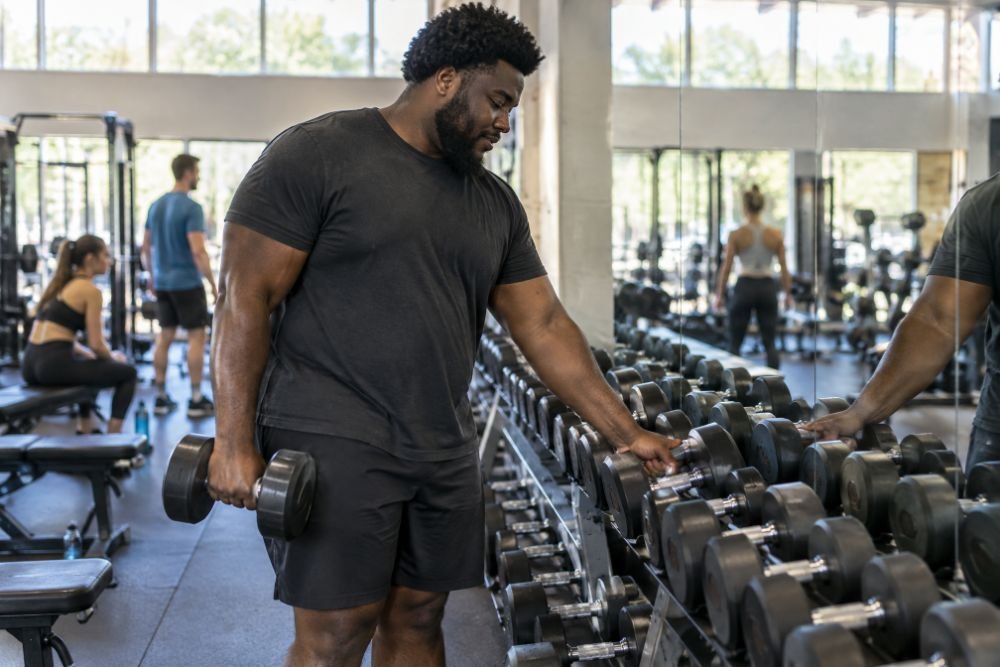
Walking Into A Gym For The First Time
Nobody writes this part down. Not the programme — the logistics. What to wear, where to stand, what the machines are called, and what actually happens if you use one wrong.
What is really going on in the room
The fear is that everyone is watching. The reality of a gym floor is that almost everyone is mid-set, between sets, or looking at their phone, and the ones who are looking around are counting down a rest timer and staring through you at a wall.
This is not reassurance. It is a description of the room. People at the gym are running their own programme, and the amount of attention available for yours is close to zero. The one exception is that experienced lifters do notice someone doing something dangerous, and their instinct is almost always to help rather than to laugh.
What to wear
- A shirt you do not mind sweating through. Technical fabric over cotton — cotton holds sweat and gets heavy and cold. A slightly loose fit is fine; nobody is assessing the cut.
- Compression shorts underneath. Long ones. This is the single most useful item on the list and nobody mentions it: it ends chafing, which otherwise decides whether week three happens.
- Flat shoes. Running shoes have a soft, compressible heel that makes squatting and deadlifting feel unstable. Any flat trainer works. Cheap canvas shoes are genuinely good for this.
- A towel and a bottle. Most gyms expect you to wipe a bench after using it. Carrying a towel makes you look like you have been there for years.
The vocabulary, so nothing has to be asked
- Rep — one repetition of a movement. Set — a group of reps done back to back. "Three sets of eight" is eight reps, rest, eight, rest, eight.
- The rack — the tall frame with adjustable hooks. Squats and presses happen here. The horizontal bars you can set at any height are safeties, and they are the reason you can fail a lift alone without consequence.
- The bar — a standard barbell weighs 20 kg or 45 lb on its own. That is worth knowing before you assume you should be adding plates.
- Collars — the clips that stop plates sliding off. Use them.
- Working in — two people sharing one piece of equipment, alternating sets. "Mind if I work in?" is the most normal sentence in a gym.
- A spot — someone standing by to help if a lift stalls. "Can you spot me?" then "three sets of eight, I'll rack it myself unless I stop moving."
- Drop set, superset, AMRAP — you will hear these. You do not need any of them for a year.
The first twenty minutes, in order
Walk in. Scan the room once from the entrance so you know where the changing rooms, the water and the free weights are. Then go and do something — standing still is the only thing that actually feels conspicuous.
Start on a machine. Not because machines are better, but because they are self-explanatory, they have a picture on them, and they let you get used to the room while doing something productive. Ten minutes on a bike or an incline walk, then two or three machines, then leave. That is a completely legitimate first session, and it is far better than an ambitious one that leaves you unable to walk on Wednesday.
Where to stand
There is an etiquette here and it is mostly about sight lines and space.
- Do not stand directly behind someone doing a lift — they may need to step back.
- Do not set up right in front of the dumbbell rack. Take the weights and move a couple of steps out so other people can reach.
- The area in front of a mirror is not reserved. People are watching their own bar path, not admiring themselves.
- Put weights back. This is the only rule anyone genuinely gets annoyed about.
- If someone leaves a towel or a bottle on a bench, they are between sets. That is what working in is for.
What happens if you do it wrong
Almost always: nothing. A machine set at the wrong seat height is uncomfortable, not dangerous. A bar path that drifts forward means the set feels hard in the wrong place. You notice, you adjust next time.
The handful of things worth getting right on day one are all about the failure case rather than the technique:
- Set the safeties. In a rack, put the horizontal bars just below the lowest point of your lift. Then a failed rep lands on steel instead of on you, and you can walk away from it.
- Do not bench alone without safeties. This is the one genuinely dangerous lift to fail unaided. Use a rack with the safeties set, or use dumbbells, or ask for a spot.
- Use collars on anything loaded unevenly. A plate sliding off one end is how a bar tips.
- Stop two reps short. On every set, for the first month. You will learn more from twelve controlled reps than from one grinding failure.
Checking the equipment fits you
This is the part written for a bigger body, and it is practical rather than emotional. Some gym equipment is sized for a 180 lb frame and it is worth knowing which before you are wedged into it.
- Weight ratings are real. Benches, machines and cardio equipment carry a maximum user weight, usually 300–400 lb on commercial kit and considerably less on cheap home equipment. Commercial gym machines are almost always fine. It is worth a glance at the sticker on anything that flexes.
- Fixed-path machines assume proportions. If a chest press pins your elbows behind your torso or a leg press folds you in half, that machine does not fit you. That is a machine problem. Free weights and cable stacks adjust to any body, which is one reason to graduate to them sooner rather than later.
- Seat belts and pads. Some machines have restraint pads that will not close on a bigger torso. Skip the machine. There is always another movement.
The three sentences worth rehearsing
Having these ready removes most of the social friction, because the hesitation is never about the words — it is about not having decided in advance.
- "Mind if I work in?"
- "How many sets have you got left?"
- "Can you show me how this one adjusts?" — asked of staff, or of anyone who looks settled. This one has a near-100% success rate and it is the fastest way to stop feeling like a visitor.
A first month that works
Two sessions a week. Six movements: something that pushes (chest press), something that pulls (row), something for the legs (leg press or a goblet squat to a box), something overhead, something for the hamstrings, and ten to twenty minutes of easy cardio. Three sets of eight to twelve on each, stopping short, adding a small amount when the last set feels easy.
That is it. It is unglamorous and it works, and after four weeks the room stops being a room you are visiting.
One last thing
You are not there to earn a place. Your body has been carrying its own weight up stairs and around a job for years, which is a training history most people never accumulate. The gym is a room with equipment in it, and you are allowed to use the equipment. That is the entire arrangement.
General information about starting exercise, not medical advice. If you have a heart condition, uncontrolled blood pressure, a recent injury or surgery, or you have been inactive for a long time and have other risk factors, get cleared by a doctor before you start — and stop and seek help for chest pain, unusual breathlessness or dizziness.