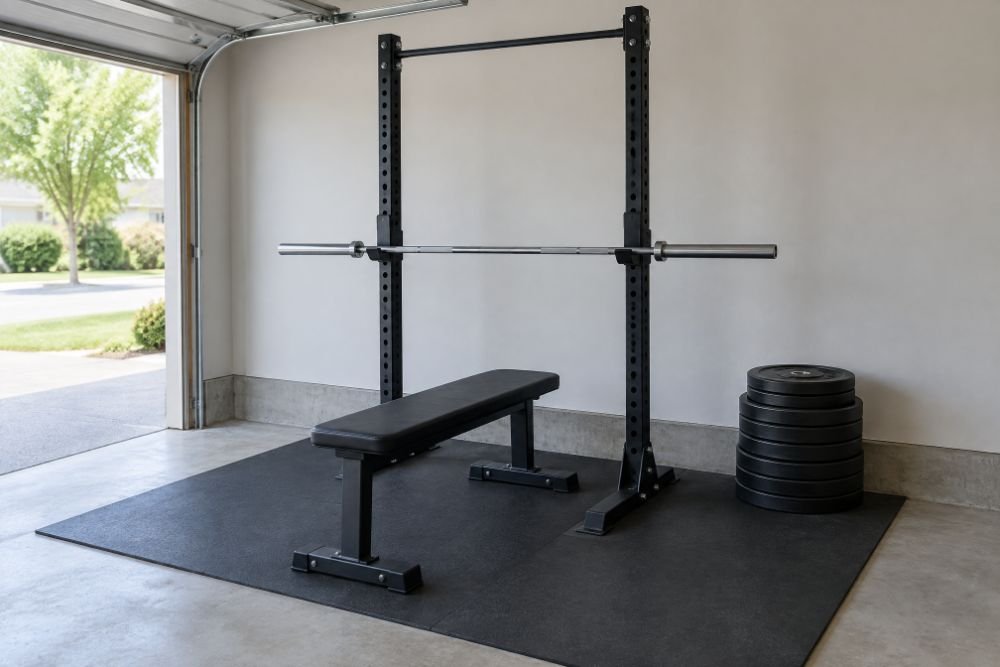
The Smallest Useful Home Gym
You do not need a room full of machines to train hard. You need a handful of things that hold real weight safely, in the right order, and the discipline to stop shopping once you have them.
What actually trains everything
A barbell, a set of plates, a rack to hold the bar at squat and rack-pull height, and a flat-to-incline bench cover the entire list of major movement patterns — squat, hinge, press, row, pull — well enough to train for years without adding anything else. That is not a compromise version of a real gym. A full-body programme run on a bar, a rack and a bench, twice to three times a week, is the same basic prescription the American College of Sports Medicine's exercise guidance recommends for developing and maintaining strength in healthy adults generally.
Garber CE, Blissmer B, Deschenes MR, et al. Quantity and Quality of Exercise for Developing and Maintaining Cardiorespiratory, Musculoskeletal, and Neuromotor Fitness in Apparently Healthy Adults. Med Sci Sports Exerc. 2011;43(7):1334–1359. Read 10 September 2026.
Everything past that short list is a nice-to-have, not a requirement, and buying the nice-to-haves before the essentials is the most common way a home gym budget disappears before the important stuff arrives.
Why the weight rating on the box matters more here
Every bench and rack ships with a maximum user weight rating, and that number is not just about your bodyweight — it needs to cover your bodyweight plus the bar, plus the extra force your body applies when you drive out of the bottom of a heavy rep rather than sitting on it gently. A bench rated for exactly your bodyweight with nothing to spare is not rated for training on; it is rated for sitting on. Look for a bench or rack rated at least a few hundred pounds above your bodyweight plus your heaviest working set, and treat manufacturer ratings as a ceiling to stay well under, not a target to approach. This is worth checking before anything else on a spec sheet — a rack that looks identical to a pricier one in every photo can carry a fraction of the rated capacity, and that number is usually printed in far smaller type than the price.
Rated capacity is also usually a static test — a fixed load placed on the equipment and left there — not a rating for the dynamic, sometimes uneven forces of an actual working set. That gap is exactly why buying with a wide safety margin matters more for a bigger lifter than the number on the box alone suggests.
The order to buy in
Buy in this order, and stop once you've covered your training rather than working down the whole list:
- 1. Plates and a bar. The actual training happens here. Buy more plates than feels necessary — running out of iron mid-programme is the single most common home-gym mistake.
- 2. A rack. Squatting and pressing safely from a rack, rather than cleaning weight off the floor every rep, is what lets you actually load a session. A rack with adjustable safety arms set just below failure depth is the single piece of equipment that makes solo heavy training safe.
- 3. A flat-to-incline bench. Covers pressing and a wide range of accessory work. An adjustable one earns its place; a fixed flat bench is the cheaper, entirely adequate alternative if the budget is tight.
- 4. A pull-up bar. Often mountable to the rack itself, and it covers the one major pattern — vertical pulling — that a bar and bench alone do not.
- 5. Flooring. Rubber matting under all of it, both to protect the floor underneath and to protect a dropped plate from bouncing somewhere unhelpful.
What to skip, at least at first
Cable towers, cardio machines, and multi-station "everything" gyms all do something a barbell and a rack cannot replicate exactly, but none of them are required to build real strength, and all of them cost more per useful training hour than the basics above. A cardio need is usually better solved by a pair of shoes and a hill, a set of stairs, or a cheap secondhand bike than by a machine that takes up a quarter of the room. Specialty bars — trap bars, safety-squat bars — are genuinely useful additions later, once the basic four items are in place and you know which movement patterns you actually want more options for.
Training solo without a spotter
Most home gyms are a one-person operation, which means the safety arms on the rack are doing the job a training partner would do in a commercial gym. Set them just below the lowest point of the movement — a couple of inches under a full squat depth, roughly chest height for a bench press — so that a missed rep sits down on steel rather than on you. This is the entire reason a rack outranks a set of adjustable dumbbells on the buying order above: dumbbells have no equivalent safety net, and a stuck heavy dumbbell press with nobody else in the room is a genuinely bad situation to be in.
It is worth practising failing a rep on purpose at a light weight before it happens for real at a heavy one — dumping the bar onto the safety arms deliberately, so the first time it happens under real load is not also the first time you've ever done it.
Space, ceiling and noise
A rack and bench need less room than people expect — roughly a car-parking-space footprint is enough for a rack, a bench and space to walk around the bar — but ceiling height is the number that actually rules rooms out. A rack with the pull-up bar attachment, plus a lifter's arms overhead, plus clearance, generally wants at least an eight-and-a-half foot ceiling; measure before buying, not after it arrives. Dropped weight is loud and the impact carries through a floor into whatever is underneath it, which matters if you're above a shared space rather than a slab garage floor. Thick rubber flooring meaningfully cuts both the noise and the impact transmitted downward, and is worth buying before the first noise complaint rather than after.
Buying secondhand without regretting it
Plates and bars are close to the ideal used purchase: steel does not wear out, and a scratched, faded plate lifts exactly as much as a new one. Racks and benches are a different story — check welds for cracking, check that safety arms and adjustment pins are not bent or seized, and sit or stand on anything before buying it rather than trusting a photo. A rack with a bent upright is not a discount; it is a hazard wearing a discount's price tag. Buy the rack once and pick up plates whenever they come up cheap locally, and the whole setup costs noticeably less spread across a year than it looks like it will in a single order.
General equipment guidance, not a substitute for reading the specific weight rating, assembly instructions and safety warnings that ship with any piece of equipment you buy. Always check a manufacturer's own stated capacity before loading anything heavily, and stop using anything that shows cracking, bending or loose hardware.