Heavy Mechanics
Most lifting advice is written for a lean 175-pound body and then handed to everyone else. If you carry more weight and more width, the standard cues can feel impossible — not because you're doing it wrong, but because they were never built for your leverages. Here's how to set up the big three around the frame you actually have.
Leverage is not a character flaw
A bigger body changes where the load sits and how your joints stack. Longer or thicker limbs, more mass through the torso, and a wider base all shift the physics of a lift. That's leverage, and it's neutral. A tall guy pulls sumo for a reason; a wide guy benches with a different grip for a reason. The goal isn't to force your body into a textbook photo — it's to find the position where the bar path is short and the joints are stacked. Once you stop apologising for your build and start lifting around it, the numbers climb fast.
There's a real physical advantage hiding in here that nobody mentions. Carrying more mass means you have been walking around under load every day for years. Your skeleton, your tendons and your postural muscles have been quietly adapting to that the entire time. This is why so many bigger beginners are startlingly strong on day one, and why the first few months of training often produce numbers that embarrass lifters who have been at it longer. You are not starting from zero. You are starting from a body that has already done a great deal of work.
The squat: build a base, not a ballet pose
Deep, narrow, heels-together squats are sold as the ideal. For a lot of big guys they just fold the belly into the hips and stall the depth. Try this instead:
- Widen the stance until your knees can track out over your toes without your torso slamming shut. A wider stance gives your midsection somewhere to go on the way down.
- Point the toes out 20–30 degrees. This opens the hips and lets you sit between your legs instead of behind them.
- Own a low bar position. Resting the bar across the rear delts shortens the moment arm on your lower back and lets you use the hips and quads together.
- Chase your depth, not the internet's. A clean squat to parallel that you control beats a collapsed "deep" one every time.
If the wider stance still feels like it jams, the limiter is usually ankles rather than hips. Try a small heel elevation — a pair of proper lifting shoes, or a five- to ten-pound plate under each heel. Raising the heel lets the knee travel forward, which lets the torso stay taller, which gives the belly more room. Lifters spend years fighting a hip problem that was an ankle problem the whole time.
One more thing worth saying plainly: the belly touching the thighs at the bottom is not a failure. It is a physical fact of squatting with a bigger midsection, and it is where your depth honestly ends that day. Fighting past it by rounding the lower back trades a few degrees of depth for a genuine injury risk. Squat to where you are solid, add weight there, and depth tends to improve on its own as body composition and hip mobility change.
The bench: a big chest is an advantage
More mass across the chest and shoulders means a shorter distance for the bar to travel — use it. Pull your shoulder blades down and together and glue them to the bench so you're pressing off a solid shelf, not soft tissue. A grip slightly wider than shoulder width keeps the forearms vertical and cuts the range even further. Plant your feet hard and drive the floor away; leg drive isn't cheating, it's how heavy benches are built. Lower to the lower chest, not the throat, and let your natural arch do the work it's already set up to do.
Two practical notes. First, if the bar bounces off your chest, you are not benching — you are catching. Touch and go is fine, but the touch should be deliberate and controlled. Second, use a spotter or safety pins for anything near a limit. A bigger lifter benching alone at home with no pins is the single most common way this lift goes badly wrong, and it is entirely preventable.
The deadlift: the great equalizer
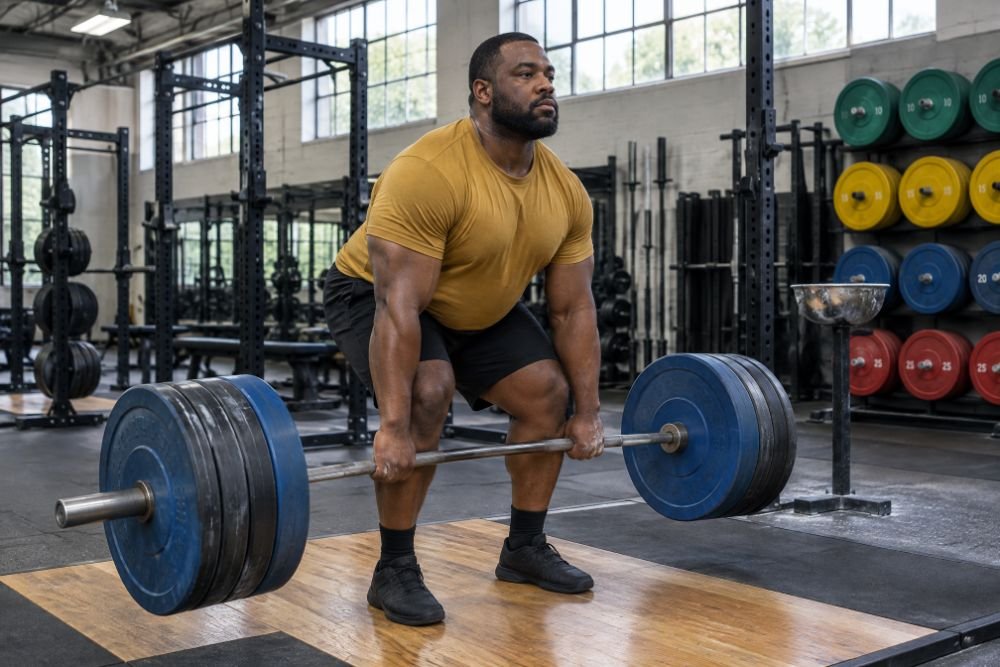
The deadlift rewards a strong back and a big body, which is why so many plus-size lifters are quietly great at it. Set up so the bar is over mid-foot and touching your shins before you pull. If your belly makes a conventional stance feel cramped, go sumo: a wide stance lets your torso stay upright and gives your midsection room. Take the slack out of the bar — pull it tight until you hear the plates click — then push the floor away and stand up tall. Brace like you're about to take a punch, from the very first rep.
Sumo is not the easy version. It is a different lift with different demands — more hip and quad, less lower back, a shorter range of motion but a much harder start off the floor. Pick the one where your setup feels solid and your back stays neutral, and stop worrying about which one counts.
If the bar cannot reach the floor without your back rounding, raise the floor. Pulling from blocks, from mats, or from the second pin of a rack is a legitimate training lift, not a scaled-down apology. Deficit pulls exist too; nobody calls those cheating because they make the lift harder. The height of the bar is a variable like any other.
Bracing and breathing
For a bigger frame, the brace is everything. Take a big breath into your belly, not your chest, and push out against your waistband in every direction. A lifting belt gives that pressure something to press against — it's a tool, not a crutch. Hold the brace through the whole rep and reset it at the top. Strong intra-abdominal pressure is what turns your size into stability instead of strain.
The most common bracing mistake is sucking the stomach in. That is the opposite of what you want. You are trying to build a rigid cylinder, and a cylinder gets rigid by pressurising outward — front, sides and back at once. If you can still speak in a full sentence at the bottom of a heavy squat, you are not braced.
On belts: buy one that is the same width all the way round, ten or thirteen millimetres thick, with a lever or a prong. The tapered nylon belts sold in most gyms are back supports, not lifting belts, and they give the brace nothing to work against. Wear it for heavy sets and take it off for the light ones so the trunk keeps doing its own job.
What to actually do about cardio
Conditioning matters, and it does not have to mean running. Impact work on a heavier frame loads the knees and ankles hard, and the usual outcome is a sore joint that stops the lifting too. The alternatives work just as well: incline walking, the assault bike, the rower, sled pushes, swimming. The Physical Activity Guidelines for Americans put the target at 150 minutes of moderate activity a week, and a brisk incline walk counts in full. Start there rather than at a couch-to-5K that your ankles have not agreed to.
How much weight, how often
Two to four sessions a week, full body or upper/lower, is plenty. Pick a weight you can move for the prescribed reps with two or three left in the tank, and add a small amount when the last rep still looks like the first. That is the whole method. Adding two and a half kilos a week to a squat is fifty kilos over ten months, and almost nobody does it because it feels too slow to be working.
Warm up by doing the movement you are about to do, lighter. The empty bar, then a third of your working weight, then two thirds, then work. General mobility drills before lifting are fine, but a bar-path rehearsal beats them for actually preparing a lift.
Start heavy, start smart
None of this requires flexibility you don't have or a body you're not in yet. It requires setting up around your real leverages and then adding weight patiently. Warm up, keep your reps clean, and add a little each week. You're not a beginner project to be fixed — you're a strong person learning to express it. Now go load the bar.
General strength-training guidance, not medical advice. If you have a known heart, joint or blood-pressure condition — and heavy bracing does spike blood pressure — talk to a doctor before starting. That is worth doing properly rather than skipping out of embarrassment.