What A Lifting Belt Actually Does
It is not a back brace. It does not hold your spine together, and it is not a licence to lift with a rounded back. It is a wall for your abs to push against — and the belt most gyms sell you cannot do the job.
The mechanism, in one paragraph
When you brace hard before a heavy lift, you take a breath, hold it, and push your abdominal wall outward against that held air. That raises the pressure inside your abdomen, and a pressurised cylinder is stiffer than an unpressurised one. A stiffer trunk transmits force better and gives the spine less room to move under load. That is the brace. The belt does not create it.
What a belt does is give the abdominal wall something rigid to push into. Push out against a belt and the pressure climbs higher and faster than it would against nothing, because the wall has somewhere to stop. The belt is the wall. Your abs are still the engine.
What the measurements show
Cholewicki and colleagues measured this directly in the European Spine Journal in 1999, testing ten people with sudden load releases while recording trunk stiffness, muscle activity and intra-abdominal pressure.
Raising intra-abdominal pressure on its own increased trunk stiffness by 21% at 40% of maximum pressure and 42% at 80% in flexion, and 16% and 30% in lateral bending. Adding a belt contributed a further 9% to 57% depending on the pressure level and the direction of the exertion.
Two things follow from those numbers, and they are the whole practical argument. The pressure did more than the belt did — so a lifter who cannot brace does not get much from a belt. And the belt's contribution was largest when combined with a hard brace — so the belt is a multiplier on a skill, not a substitute for one.
The authors also flagged that belt use came with reduced activation in some trunk extensors, which is the honest counterweight: wear one for everything and the musculature that would otherwise do the work gets a quieter time.
Cholewicki J, Juluru K, Radebold A, Panjabi MM, McGill SM. Lumbar spine stability can be augmented with an abdominal belt and/or increased intra-abdominal pressure. European Spine Journal. 1999;8(5):388–395. Read 4 September 2026.
The belt in most gyms is the wrong tool
Walk into a commercial gym and the belts on the rack are almost always the same design: nylon, wide and padded at the back, tapering to a narrow strap at the front, fastened with velcro or a lever. That shape is a back support, borrowed from warehouse and occupational use. It is built to remind a worker not to bend badly over an eight-hour shift.
For lifting, the shape is backwards. You brace against the front of your abdomen, so the front is exactly where you need material. A belt that is 15 cm at the back and 5 cm at the navel gives you the most support where you need it least.
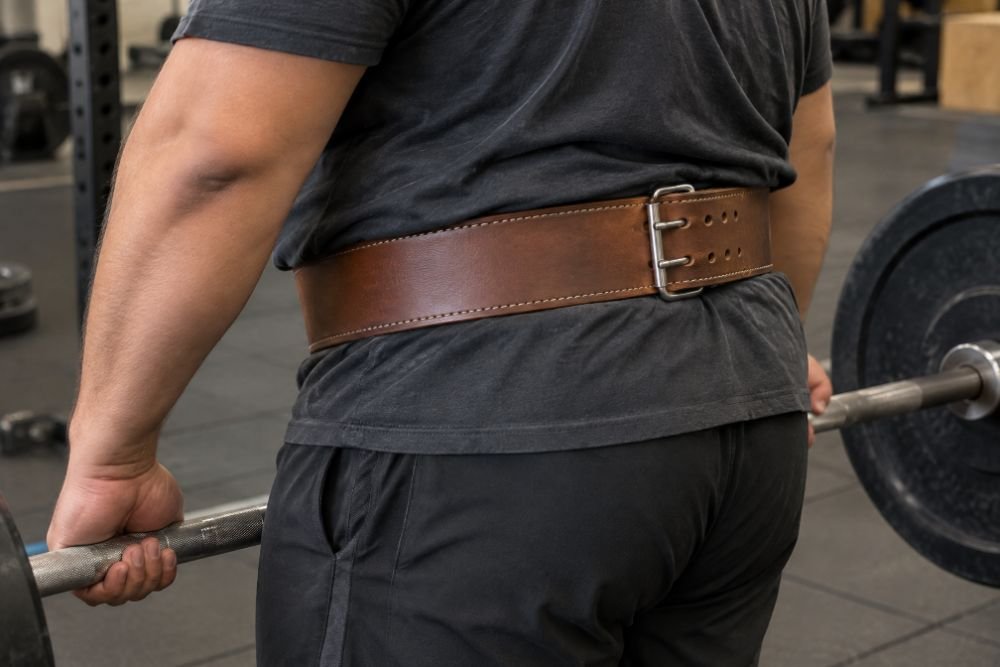
A lifting belt is a uniform width all the way round — typically 10 cm (4 inches), sometimes 7.5 cm for people with a short torso — and stiff enough that it does not deform when you push into it. Leather at 10–13 mm thick is the standard, fastened with a prong or a lever. It should feel more like a section of barrel than like clothing.
It is also worth saying that the occupational evidence for back belts as an injury-prevention device is weak; systematic reviews of workplace back belts have not found that they prevent first-time low back pain. That finding is often quoted at lifters as though it settles the question. It does not: preventing back pain in a warehouse and adding trunk stiffness to a maximal squat are different claims, tested in different populations, with different equipment.
Buying one when you are a bigger lifter
This is where most articles stop being useful, so here is the specific version.
- Measure at the navel, not at the trouser waist. Belt sizing is based on where the belt actually sits, which is higher than where trousers sit. Measure over a t-shirt, standing relaxed, and buy from that number.
- Check the size range before you fall in love with a brand. A lot of well-regarded lifting belts stop around 44 or 46 inches. Several makers go to 50 or beyond, and single-prong or lever designs are usually available in the wider range. If a company's size chart ends where you begin, that is information about the company.
- Prong versus lever. A lever is faster on and off but is bolted to one hole position, so changing tightness means unscrewing it. A single prong is slower and adjusts freely, which matters more if your waist is changing. For a first belt, a single prong is the safer purchase.
- 10 cm all round, 10 mm thick. If a 13 mm belt digs into your ribs or hips, the belt is too tall for your torso, not too thick — look at 7.5 cm rather than going softer.
- New leather is unpleasant for a month. That is normal and it is not a defect. It softens.
How to actually use it
The most common error is wearing it too tight. If you cannot expand into it, there is nothing to push against and you have simply constricted yourself. Fasten it so you can slide a flat hand between the belt and your stomach when relaxed — then, when you take your breath and push out, it should become genuinely snug.
- Breathe in through the mouth, low and wide. Not a chest breath. The belly and the sides of the waist should expand into the belt in every direction.
- Push out, do not suck in. Bracing is the opposite of holding your stomach in.
- Hold the breath for the rep. One breath, one rep, on the heavy sets. Exhale at the top, re-brace, go again.
- Position: most people find it sits best just above the hip bones, low enough not to catch the ribs when the torso folds forward. Deadlifters often wear it a little higher than squatters.
When to take it off
The belt belongs on your heavy compound sets and off everything else. Warm-ups, accessory work, machines, moderate sets, anything under about 80% of your top weight — unbelted. That is not asceticism. It is that the unbelted sets are the ones training the bracing musculature that makes the belted sets work, and the 1999 data showing reduced extensor activation under a belt is the reason to care.
A reasonable rule: if you can do the set without thinking about your brace, you do not need the belt for it.
What a belt cannot do
It will not fix a rounded back. It will not make a weight safe that was not going to be safe. It will not prevent an injury caused by a jump in load your tissues had not been prepared for — which is what most training back injuries actually are.
And it is not required. Plenty of strong people have never owned one. If the belt is being bought because your back hurts when you lift, the belt is the wrong purchase; that is a technique, load-management or medical question, and putting leather over it just delays the answer.
The honest summary
A proper lifting belt, worn on heavy sets by someone who already knows how to brace, adds a measurable amount of trunk stiffness — somewhere between a little and a lot depending on how hard you are bracing. That is a real benefit and it is worth about eighty dollars. It is not a safety device, it is not a back support, and the nylon tapered thing in the corner of the gym is a different product wearing a similar name.
General information about training equipment, not medical advice. Breath-holding under heavy load raises blood pressure sharply, so if you have high blood pressure, a heart condition, glaucoma, or a hernia, talk to your doctor about bracing and belt use before you adopt it. Back pain that is new, severe, or radiating down a leg needs assessment rather than equipment.