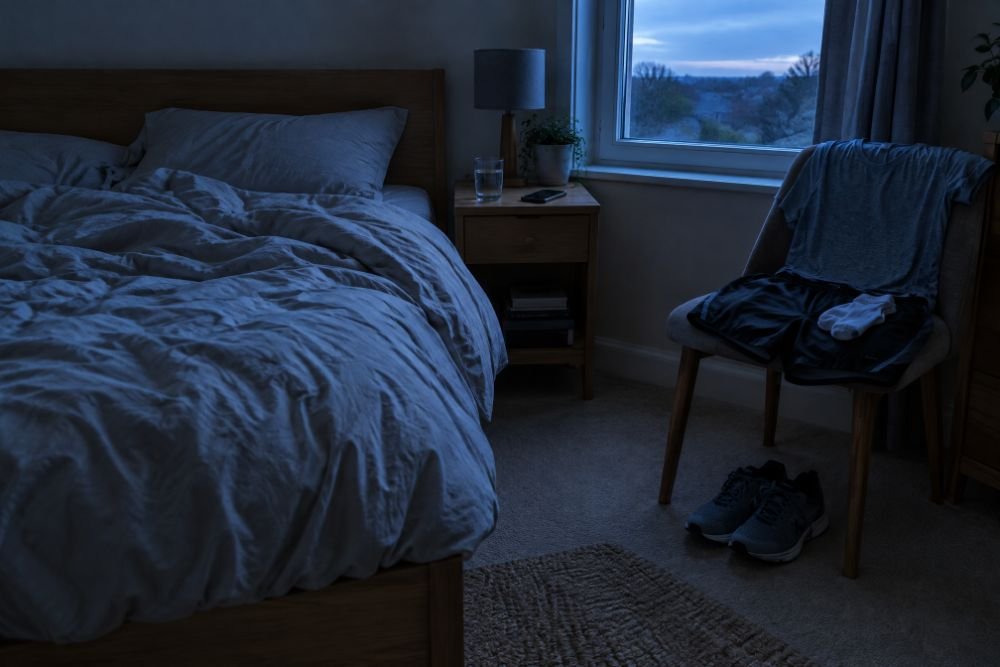
Sleep Is A Training Variable
You can control your programme, your protein and your effort. Sleep sits in the same list, has a bigger effect than most supplements, and is the one variable big men are most likely to have a fixable medical reason for losing.
What sleep loss actually costs in the gym
This has been measured properly. A 2022 systematic review and meta-analysis in Sports Medicine pooled 227 outcome measures from 69 studies on acute sleep loss and physical performance. The overall effect was a 7.56% drop in performance (95% CI −11.9 to −3.13).
Two details from that paper are more useful than the headline. First, timing: "the negative effects of sleep loss on different exercise tasks performed in the PM were consistent, while tasks performed in the AM were largely unaffected." Second, the dose-response — performance fell by roughly 0.4% for every additional hour spent awake before the task.
Put those together and you get something immediately actionable. After a bad night, your morning session is close to normal and your evening session is where the loss shows up. If you slept badly and you train at seven in the evening, that is the day to keep the weight the same rather than chase a personal best — or to move the session to the morning.
Craven J, McCartney D, Desbrow B, Sabapathy S, Bellinger P, Roberts L, Irwin C. Effects of Acute Sleep Loss on Physical Performance: A Systematic and Meta-Analytical Review. Sports Medicine. 2022;52(11):2669–2690. Read 4 September 2026.
Why one bad night is not the real problem
A single short night costs you a few percent and you get it back. The thing that quietly wrecks a training year is the chronic version — six hours a night for months — because it does not feel like anything. People adapt to feeling slightly worse and stop noticing the baseline moved.
What that does to training is not mysterious. Recovery between sessions slows, so the same programme starts to feel like too much. Perceived effort rises, so a weight you have handled for weeks feels heavy and you do fewer reps without deciding to. And appetite regulation shifts — short sleep reliably increases hunger, particularly for fast carbohydrate, which makes hitting a protein target harder for reasons that have nothing to do with discipline.
The part that gets skipped, and shouldn't
Here is where an article for big guys has to say something an article for everyone else does not.
If you carry more weight, obstructive sleep apnoea is substantially more likely, and it is very commonly undiagnosed. Chest puts the prevalence in obese and severely obese patients at nearly twice that of normal-weight adults, and above 70% among people presenting for bariatric surgery. The relationship runs in both directions and it is steep: patients with mild apnoea who gain 10% of their body weight face a sixfold increase in the risk of progression, and an equivalent loss improves severity by more than 20%.
None of that is a comment on anyone's body. It is a mechanical fact about airways, and it is worth saying plainly for one reason: sleep apnoea is treatable, treatment works quickly, and the people most likely to have it are the least likely to have been asked about it.
Romero-Corral A, Caples SM, Lopez-Jimenez F, Somers VK. Interactions Between Obesity and Obstructive Sleep Apnea: Implications for Treatment. Chest. 2010;137(3):711–719. Read 4 September 2026.
Signs worth taking to a doctor
Not to self-diagnose — the diagnosis is a sleep study, and it is often done at home now with a device you wear for a night. But these are the things that should trigger the conversation:
- Loud snoring, especially if a partner has described pauses, gasping or choking.
- Waking unrefreshed after a full night, most nights.
- Falling asleep during the day when you did not intend to — in front of the television, in a meeting, at a red light.
- Morning headaches, or a dry mouth on waking.
- Waking repeatedly to use the bathroom.
- Blood pressure that is high and not responding well to treatment.
What people report afterwards is remarkably consistent: not "I sleep better" but "I did not know what being awake felt like." If training has felt inexplicably heavy for a year, this is worth ruling out before you rewrite your programme.
The boring things that actually move sleep
Sleep advice is a crowded market and most of it is noise. Four things carry most of the effect:
- A consistent wake time, including weekends. Wake time anchors the whole rhythm far more reliably than bedtime does. Choose one and hold it within about an hour.
- Light early, dim late. Ten minutes of daylight within an hour of waking, and lower light in the last hour of the evening. This does more than any screen-filter setting.
- Caffeine has a long tail. Half of a dose is still in you six hours later. A three o'clock coffee is a bedtime decision.
- Alcohol is a sedative, not a sleep aid. It shortens time to falling asleep and then fragments the second half of the night, which is the half where most of the recovery happens.
Two more that specifically help bigger sleepers: sleeping on your side rather than your back, which meaningfully reduces airway collapse for many people, and keeping the room genuinely cool. Body mass makes heat harder to shed overnight, and being too warm is an under-rated cause of 3 a.m. waking.
How to train around the sleep you actually got
Not every week allows eight hours. Shift work, small children and a demanding job are not character flaws. So the useful question is what to do on a Tuesday after five hours.
- Keep the session, cut the intensity. Same movements, same sets, roughly 10–15% off the weight, stopping well short. You keep the habit and the technique practice, and skip the part that needs recovery you do not have.
- Move it earlier if you can. The morning is where the meta-analysis found performance was largely unaffected.
- Drop the novelty. A bad-sleep day is the wrong day to learn a new lift or test a max. Do the movements your body already knows.
- Do not stack it. One short night is a rounding error. Four in a row with hard training on top is how people end up deloading involuntarily.
What to do this week
Pick a wake time and hold it for seven days. Move your last coffee before two. And if two or more of the apnoea signs above sound like your last year, book the appointment — it is one conversation, the test is easier than it sounds, and it is the highest-leverage thing on this entire site for the people it applies to.
General health information, not medical advice, and nothing here diagnoses anything. Suspected sleep apnoea needs a clinician and a sleep study — it is strongly associated with high blood pressure, heart rhythm problems and daytime accidents, so it is worth raising rather than working around. Persistent insomnia, and daytime sleepiness severe enough to affect driving, are also reasons to see a doctor rather than to adjust a routine.