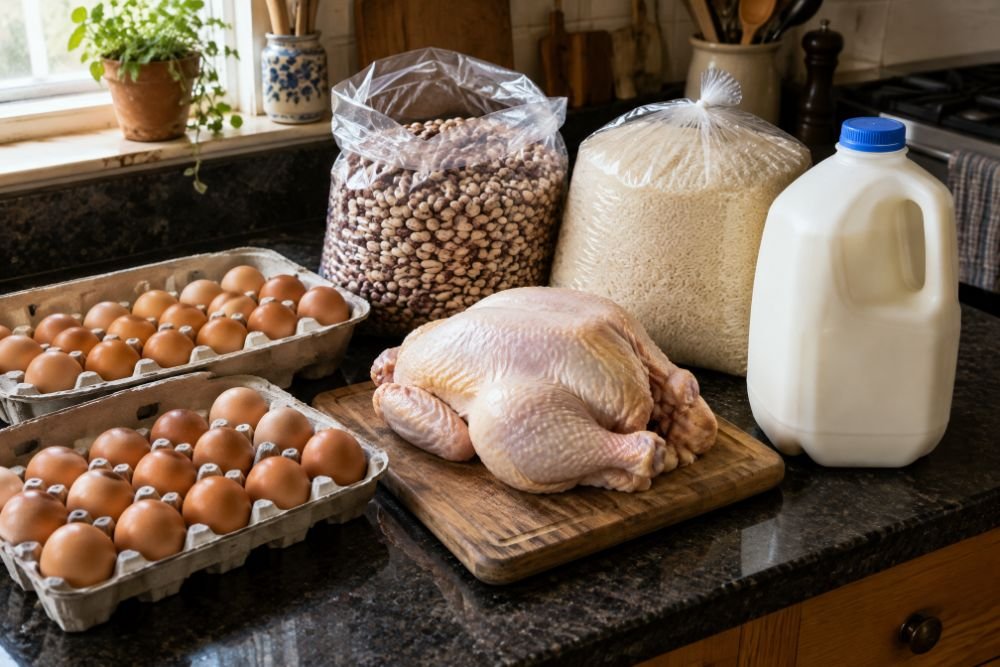
Protein Per Pound, Ranked
Every "eat more protein" article assumes the protein is free. It is not, it is the most expensive thing in the trolley, and the gap between the cheapest source and the one everybody buys is a factor of five.
How much you actually need
Start with the target, because most people overshoot it and then conclude they cannot afford to eat properly.
The International Society of Sports Nutrition's position stand puts it at 1.4–2.0 g of protein per kilogram of bodyweight per day for building and maintaining muscle in people who train, with a per-meal dose of about 0.25 g/kg, or an absolute 20–40 g.
Now the correction this site keeps making, because it matters more here than anywhere. Those figures are per kilogram of bodyweight, drawn largely from lean study populations. Multiply straight through at 140 kg and you get 280 g a day, which is both miserable and unnecessary — protein requirements track lean mass, not total mass. Calculate against a goal weight or an estimated lean mass instead. For most big guys who train, that lands somewhere between 140 g and 190 g a day.
That correction is worth real money. The difference between 190 g and 280 g a day, at ground-beef prices, is about eight dollars a day. Nearly three thousand dollars a year, to hit a number nobody needed.
Jäger R, Kerksick CM, Campbell BI, et al. International Society of Sports Nutrition Position Stand: protein and exercise. J Int Soc Sports Nutr. 2017;14:20. Read 4 September 2026.
The ranking
Below is the cost of 100 grams of protein from nine staples. Prices are U.S. city average retail prices published by the Bureau of Labor Statistics for July 2026, read via FRED; protein per unit is the USDA FoodData Central value for the raw item. The last column is arithmetic on those two figures, and is labelled as ours rather than anyone's official number.
| Source | Price | Protein per unit | Cost per 100 g protein |
|---|---|---|---|
| Dried beans, any type | $1.69 / lb | ~98 g | $1.72 |
| Chicken, fresh, whole | $2.01 / lb | ~82 g | $2.45 |
| Eggs, grade A, large | $2.19 / dozen | ~76 g | $2.88 |
| Rice, white, long grain | $1.10 / lb | ~32 g | $3.44 |
| Milk, whole | $4.31 / gallon | ~125 g | $3.45 |
| Chicken breast, boneless | $4.15 / lb | ~105 g | $3.95 |
| American processed cheese | $4.75 / lb | ~85 g | $5.59 |
| Ground beef, 100% beef | $6.89 / lb | ~78 g | $8.83 |
| Potatoes, white | $0.94 / lb | ~9 g | $10.44 |
Prices: Bureau of Labor Statistics average price data, U.S. city average, July 2026, read via FRED on 3 September 2026 — the per-series links are in the table on the meal-plans page. Protein values: USDA FoodData Central. Cost per 100 g protein is our own arithmetic on those two figures, rounded.
Five things that table tells you
1. Dried beans win, and it is not close
At $1.72 per 100 g of protein, dried legumes are the cheapest protein in the shop by a distance — a fifth of the cost of ground beef. The catch is real and worth naming: plant proteins are less concentrated per calorie and lower in leucine, so the same gram is doing slightly less work for muscle repair. In practice that argues for beans as the base of the day rather than the entirety of it, not against them.
2. Buy the whole bird
A whole chicken is $2.01 a pound. Boneless breast is $4.15. Per 100 g of protein that is $2.45 against $3.95, and the difference is about ten minutes with a knife. Two birds a week is roughly thirty dollars a month, and the carcasses make the stock that turns a bag of beans into dinner.
3. Eggs are the most under-rated line in the table
$2.88 per 100 g of protein, no cooking skill required, keeps for weeks, and a dozen boiled eggs in the fridge solves more meals than any other single purchase. Four eggs is roughly 25 g of protein for about seventy cents.
4. Ground beef is a flavour purchase, not a protein purchase
At $8.83 per 100 g of protein it is five times the cost of beans. That is not an argument for never buying it. It is an argument for buying one pound and stretching it with lentils, beans or TVP in a chili — a swap nobody detects in a heavily spiced dish, and which halves the cost of the pot.
5. Potatoes are not a protein source
They are on the table to make a point: cost per pound and cost per gram of protein are different questions, and cheap-per-pound food can be the most expensive protein in the shop. Potatoes are excellent, volume-heavy, satisfying carbohydrate. Just do not count on them for the number.
Where the money actually leaks
- Protein bars. Typically 20 g for two to three dollars, which is $10–15 per 100 g of protein — worse than steak. They are a convenience product priced as one.
- Pre-cut and pre-marinated anything. Diced chicken, marinated fillets and bagged shredded cheese all carry a labour premium of 30–60%.
- Single-serve dairy. Small yoghurt pots run two to three times the price per ounce of the largest tub.
- Meat substitutes. Packaged vegan mince and bean burgers usually cost more per gram of protein than the meat they replace, and considerably more than the dried legumes they are made from.
- Buying protein you were not going to eat. The most expensive protein in the house is the pack that goes off on Thursday. Freeze on the day you buy, not on the day it turns.
The one supplement that survives the arithmetic
Whey protein, bought as a plain 5 lb bag rather than a branded tub, generally lands around $3–5 per 100 g of protein — roughly chicken-breast money, with no cooking and no waste. It is not magic and it is not necessary, but it is the only item in the supplement aisle that is competitive on the metric that matters. A plant blend costs a little more and does the same job.
Everything else in that aisle — BCAAs, glutamine, mass gainers — is expensive protein wearing a different label.
A week at 170 g a day, cheaply
Roughly 1,190 g of protein across seven days. One way to buy it:
- 4 dozen eggs — about 300 g of protein, roughly $8.75
- 2 whole chickens, jointed at home, say 8 lb — about 650 g, roughly $16
- 2 lb dried beans or lentils — about 195 g, roughly $3.40
- 1 gallon of milk — about 125 g, roughly $4.30
- 1 lb ground beef, stretched with lentils — about 78 g, roughly $6.90
That is about 1,350 g of protein for roughly $39 — before any vegetables, rice, oats or oil, which is where the rest of a $60–70 week goes. The same protein bought as boneless breast and protein bars would cost between two and four times as much.
The rule underneath all of it
Buy the top of the table for the base of the week, and the bottom of the table for the meals you look forward to. A week built on eggs, whole chickens and beans with a steak on Saturday costs about half of the reverse, and tastes better than the version where every meal is chicken breast and misery.
General nutrition information, not individual dietary advice. Prices are national averages and yours will differ. If you have kidney disease, are on a protein-restricted diet, or take medication affected by diet, the protein targets above are not for you without a clinician's input — talk to a registered dietitian.