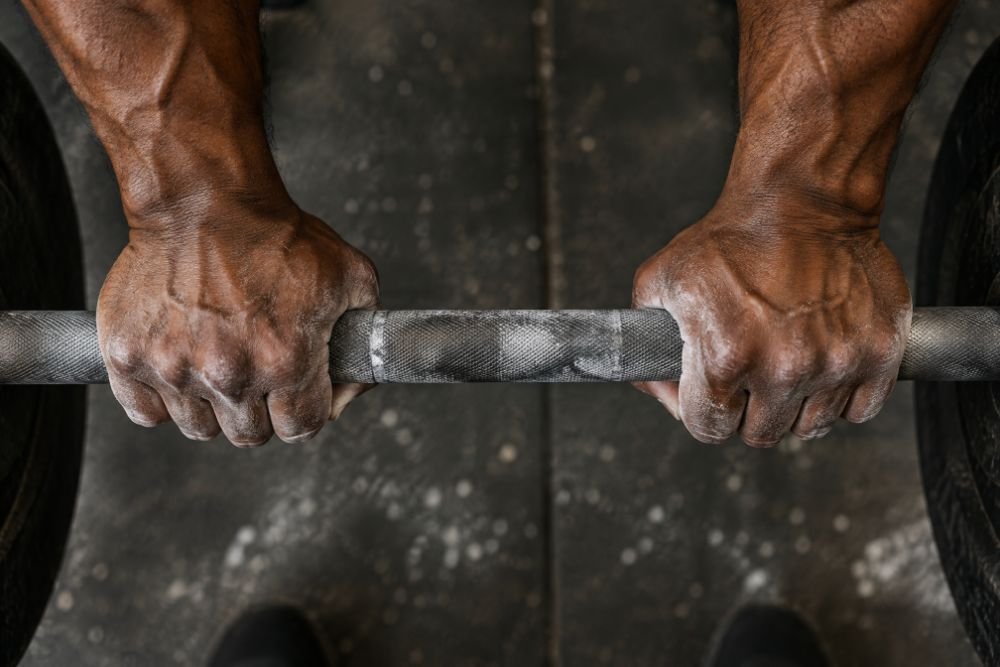
Grip Is The Thing That Fails First
Your back can pull more than your hands can hold onto. That's not a flaw in your training — it's just how the arithmetic of a deadlift works, and it's why grip deserves its own plan instead of an afterthought.
Why grip gives up first
The muscles that move a heavy bar — glutes, hamstrings, spinal erectors, lats — are some of the largest in the body. The muscles that hold onto the bar are the small ones running down your forearm, and they simply do not scale the same way. On a heavy set of deadlifts or rows, it is common to be able-bodied enough to move the weight for another two or three reps while your hands are already done. That is not weakness. It is a mismatch between two systems that were never built to fail at the same time.
This matters more, not less, at a bigger bodyweight. A heavier frame usually means a stronger posterior chain from years of simply carrying itself around, which widens the gap between what your back can pull and what your hands can hold. Grip becomes the limiting factor earlier in a training career for a big guy than it does for someone smaller, and the fix is to train it on purpose rather than assume it will keep up.
Double overhand, hook, mixed — the actual tradeoffs
Three grips show up on a deadlift bar, and each one is a different trade.
- Double overhand — both palms facing you. Symmetrical, easiest to learn, and the first thing to slip once the bar gets heavy, because nothing is stopping the bar rolling out of your fingers.
- Hook grip — your thumb goes under the bar first, your fingers clamp over the top of it. It is genuinely uncomfortable for the first few weeks and most people want to quit on it immediately. It is also symmetrical, and it holds more weight than a double overhand grip ever will, which is why it is standard in Olympic weightlifting.
- Mixed grip — one palm forward, one palm back. It holds the most weight of the three with the least practice, which is exactly why it is the default in most gyms. The bar physically cannot roll out of a mixed grip the way it can out of a double overhand one.
The mixed grip's popularity is also its problem. With one forearm supinated (palm up) and the elbow extended under load, the biceps tendon on that side takes an unusually direct pull. A video-analysis study of distal biceps tendon ruptures during deadlifting found that in every mixed-grip injury reviewed, the tear happened on the supinated arm — the underhand side — not the overhand one.
Kapicioglu M, Bilgin E, Guven N, Pulatkan A, Bilsel K. The Role of Deadlifts in Distal Biceps Brachii Tendon Ruptures: An Alternative Mechanism Described With YouTube Videos. Orthop J Sports Med. 2021;9(3):2325967121991811. Read 10 September 2026.
That does not mean mixed grip is reckless — most people who use it for years never tear anything. It means the risk is not evenly spread across your two arms, and it is a real enough pattern that swapping which hand goes under from set to set, or moving to hook grip once you can tolerate it, is a reasonable trade for a lift where the whole point is loading up heavy for years.
Straps are a tool, not cheating
There is a persistent idea in gyms that straps are for people who have not built real grip strength yet, and that using them is a shortcut you should feel bad about. The evidence points the other way. A study measuring grip fatigue and bar velocity across sets of deadlifts found that lifting straps preserved grip strength better across a session, sped up recovery of grip strength between sets, and let lifters report feeling both more secure and less exhausted at the same loads.
Jukic I, García-Ramos A, Baláš J, Malecek J, et al. Ergogenic effects of lifting straps on movement velocity, grip strength, perceived exertion and grip security during the deadlift exercise. Physiol Behav. 2021;229:113283. Read 10 September 2026.
The honest way to use them: straps let you overload the muscles a lift is actually meant to train — back, hips, hamstrings — on days when grip would otherwise cut the set short before those muscles are fully worked. They are not a way to avoid training grip at all. The two things you want are separate goals, and a sensible split is to pull without straps on lighter, higher-rep back work where grip can keep up, and save straps for the heaviest pulls of the week where the point of the set is the back, not the hands.
Training the grip on purpose
Grip strength is worth training even outside what it does for your lifts. In a large multi-country cohort study, grip strength predicted all-cause mortality more strongly than systolic blood pressure did, which is a striking result for something this simple to measure.
Leong DP, Teo KK, Rangarajan S, et al. Prognostic value of grip strength: findings from the Prospective Urban Rural Epidemiology (PURE) study. Lancet. 2015;386(9990):266–273. Read 10 September 2026.
That is a marker of overall health rather than proof that grip training itself extends your life, and the caveat below covers that distinction. Either way, three simple additions build real grip capacity without needing new equipment:
- Farmer carries. Pick up something heavy in each hand and walk. Simple, brutally effective, and it trains the exact "hold this while everything else works" pattern a deadlift demands.
- Dead hangs. Hang from a pull-up bar for time. Add a weight belt once bodyweight stops being a challenge.
- Plate pinches. Pinch two smooth-sided plates together between finger and thumb and hold. This trains the exact grip a hook or double overhand pull uses, without the rest of the lift getting in the way first.
Ten minutes of this at the end of a session, twice a week, is enough to move the needle in a few months.
Callus care nobody mentions
Calluses are your hands adapting to the bar, and a moderate amount of built-up skin is protective, not a problem. The injury that actually stops training weeks is a callus that tears — a flap of skin ripping away mid-set, which is painful, bleeds, and takes a week or two out of any pulling work while it heals.
The fix is boring maintenance, not fear of the bar: file thick calluses down with a pumice stone or callus file every week or two rather than letting them build into a ridge that catches and tears. Keep the skin from drying out and cracking with a basic hand lotion on rest days. If a tear happens anyway, clean it, trim the loose flap rather than picking at it, cover it, and switch to strapped or gloved work until it closes over — pulling on an open tear invites infection for no real training benefit.
General training information, not medical advice. If you notice persistent numbness, tingling, or weakness in your hands rather than ordinary grip fatigue, that can indicate a nerve issue such as carpal tunnel syndrome and is worth a clinician's assessment rather than working through it.