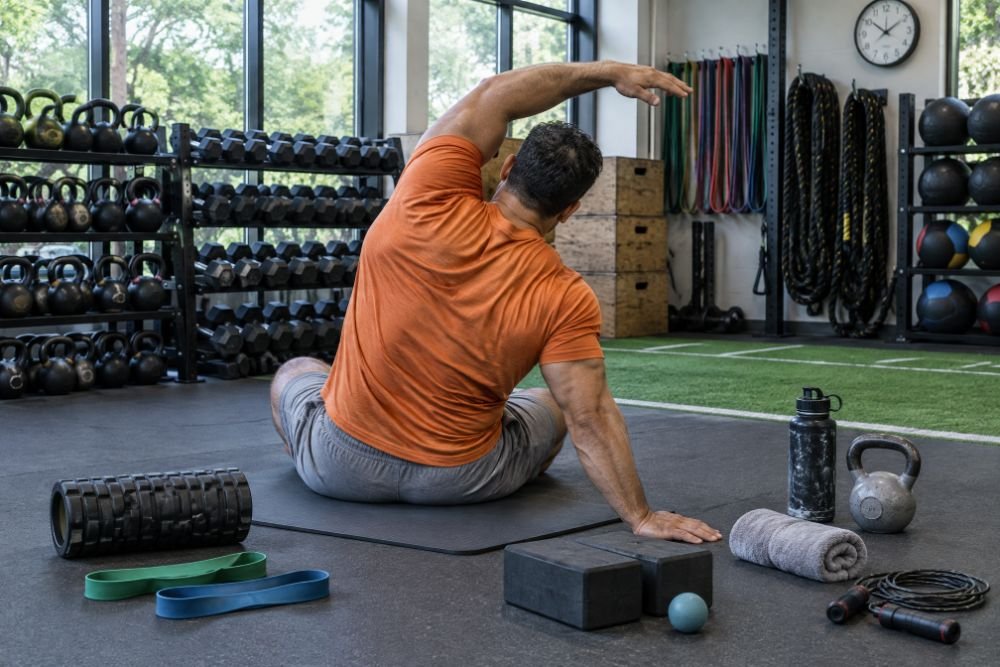
Big Guy Mobility
You don't need to touch your toes to be mobile. You need enough clean range in the right joints to squat, press and pull without pain — and to get off the floor without a strategy meeting. Mobility for big guys isn't about becoming a gymnast. It's about earning the range your lifts actually ask for.
Mobility vs. flexibility
Flexibility is how far a joint can be pushed passively. Mobility is how much of that range you can control under load. That distinction matters when you carry more mass: the tissue is there, the joint works, but the control gets buried under bodyweight and habit. The fix isn't heroic stretching — it's short, frequent, loaded drills that teach your joints to open and hold. Ten focused minutes most days beats an hour of misery once a week.
Shoulders: room to press overhead
Tight shoulders turn every overhead press into a lean-back. Open them up without forcing an end-range you don't own yet:
- Wall slides. Back to a wall, arms in a goalpost, slide up and down keeping the forearms as close to the wall as you can. Chase millimetres, not miracles.
- Band pull-aparts. Two to three sets of 15 with a light band before you press. Cheap, fast, and they wake up the upper back that holds your shoulders in place.
- Bar hangs. Even a partial-weight hang from a bar decompresses the shoulders and grows overhead range over time. Take some load off with your feet if you need to.
Hips: the key to every squat
For big guys, hip range is where squats live or die. The belly needs somewhere to go and the hips need to open enough to let you sit down between your legs. Work these:
- 90/90 sits. Sit on the floor with one shin in front and one to the side, both knees at 90 degrees. Rotate slowly side to side. This builds the internal and external hip rotation your squat stance needs.
- Deep goblet squat holds. Hold a light weight at your chest and sit into your lowest comfortable squat. Use the weight as a counterbalance and let gravity gently open the hips. Breathe. Thirty seconds at a time.
- Half-kneeling hip flexor stretch. Tuck the pelvis, squeeze the back glute, and feel the front of the trailing hip lengthen. Long days of sitting shorten this — undo it daily.
Ankles: the quiet limiter
Stiff ankles wreck squat depth and shove your weight onto your toes. The knee-to-wall drill fixes more than people expect: put your foot a few inches from a wall and drive your knee forward past your toes without the heel lifting. Find the distance where your knee just touches, and work to push it further over a few weeks. Do it before you squat and your depth improves the same session. Heel-elevated squats (plates or a wedge under the heels) are a legitimate tool, not a cheat, while you build the range.
Getting up and down with ease
Mobility isn't just for the barbell — it's for life. Practise getting to the floor and back up without using your hands, or with as little help as possible. This one skill protects your knees, hips and dignity for decades. Turkish get-ups with a light weight (or no weight) drill the whole chain: floor to standing, controlled, one joint at a time.
Keep it small and constant
You will not stretch your way to a new body, and you don't need to. Pick two drills for your worst joint, do them before you train and again on off days, and let the range accumulate. Mobility built this way sticks, because you're not borrowing flexibility — you're building control you actually own.
The thoracic spine, and why your shoulders get blamed for it
A great deal of what gets called a shoulder problem is a mid-back problem. If the upper spine cannot extend, the arms cannot get overhead without the ribs flaring and the lower back taking the difference. On a bigger frame this shows up early, because sitting is more comfortable than standing and the mid-back spends most of the day rounded.
- Foam roller extensions. Roller across the mid-back, hands supporting the head, extend back over it a few inches at a time. Move the roller up an inch and repeat. Do not let the lower back arch to fake the range.
- Open books. Lie on your side, knees bent and stacked, arms straight out in front. Open the top arm across your body and follow it with your eyes. Ten a side, slowly.
- Bench thoracic stretch. Kneel at a bench, elbows on it, sink the chest toward the floor. This one earns overhead range faster than almost anything else.
Breathing is a mobility drill
This sounds soft and it is not. Carrying more weight through the trunk changes how the diaphragm and ribcage move, and a chest-dominant breathing pattern keeps the ribs flared and the mid-back locked. Lie on your back, knees bent, one hand on your chest and one on your belly. Breathe so that only the lower hand moves, and make the exhale twice as long as the inhale. Five minutes. It does more for a stiff mid-back than most stretches, and it directly improves the brace you use under a bar.
A ten-minute daily order
Do these in this sequence, most days. It is short enough to actually happen.
- 90/90 hip rotations — 8 each side
- Half-kneeling hip flexor stretch — 30 seconds each side
- Knee-to-wall ankle drill — 10 each side
- Foam roller thoracic extensions — 6 positions
- Band pull-aparts — 20
- Deep goblet squat hold — 30 seconds, twice
Before a training session, do the same list faster and skip the long holds. Long static stretching immediately before heavy lifting can temporarily reduce force output, so save the thirty-second holds for after, or for a rest day.
Pain is information, not a verdict
Discomfort at the end of a stretch is normal. Sharp pain, pins and needles, or anything that travels down a limb is not, and it means stop and get it looked at. There is a particular habit among bigger lifters of assuming every ache is just the weight and pushing through it. Sometimes it is. Sometimes it is a rotator cuff or a disc, and the difference is worth a physiotherapist's forty minutes.
Warming up when the floor is a long way away
A fair amount of standard mobility work assumes you can get down to the floor and back up several times in a session without it being an event. If that is not currently true, do not skip the work — move it up off the floor. Nearly every drill has a standing or elevated version:
- Hip flexor stretch — instead of half-kneeling, stand in a long split stance with the back heel down and tuck the pelvis.
- 90/90 — sit on a low bench with one leg out to the side rather than on the floor.
- Thoracic extension — hands on a rack upright at chest height, step back and sink the chest between the arms.
- Ankle drill — unchanged. This one is already standing.
Then work getting to the floor as its own skill, separately, when you are fresh. Bench, to box, to floor, over a few weeks. The point is not to avoid the floor permanently; it is to stop the first minute of a warm-up being the hardest part of the session.
General information about mobility work, not medical advice. Stretching into sharp, shooting or radiating pain is not a range problem and pushing through it is how a small thing becomes a long one — that belongs to a physiotherapist or a doctor, as does any joint that locks, gives way or swells. If you have had a joint replacement, a recent injury or surgery, or a diagnosed instability, your clinician's protocol outranks everything on this page.