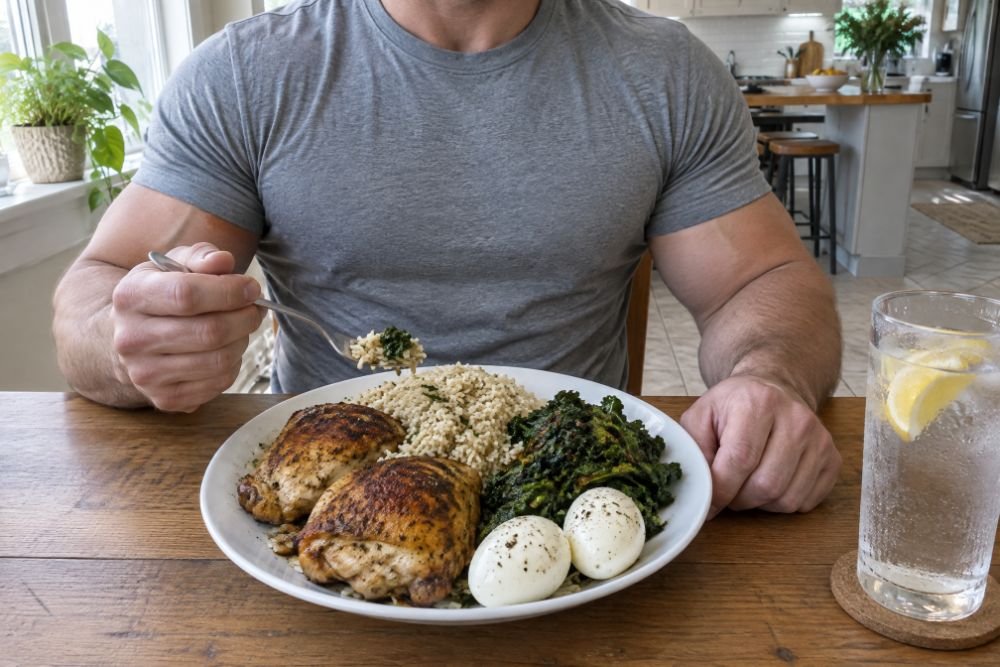
Real Fuel
You've been sold the idea that getting healthier means eating less of everything and feeling hungry as a lifestyle. That's not nutrition — it's punishment. If you're training hard, you need to eat like it. This is how to fuel strength without shame, without starvation, and without a single "cheat day" confession.
Food is fuel, not a moral test
There are no good foods and bad foods, and there's certainly no bad you for eating them. A plate is a tool: it delivers protein to rebuild muscle, carbs to power your lifts, and enough total energy to recover. When you frame eating as a test you keep failing, every meal becomes a source of guilt. When you frame it as fuelling a body that works hard, the whole thing gets simpler — and the results get better.
Protein is the priority
If you change one thing, change this: eat more protein, spread across the day. Protein is what actually builds and holds the muscle you're training for, and it's the most filling macronutrient by a wide margin — so it does the appetite work that crash diets try to do with willpower. Aim for a palm-sized (or bigger) protein source at every meal:
- Anchors: chicken thighs, beef, eggs, Greek yoghurt, cottage cheese, fish, tofu, lentils.
- Rule of thumb: build every plate around the protein first, then add the rest. If protein is handled, the day mostly takes care of itself.
- Convenience counts: a protein shake, a tin of tuna, or a tub of yoghurt is real food when real cooking isn't happening.
Volume eating: full, not deprived
Here's the part nobody tells big guys: you can eat a genuinely large amount of food and still feel great, if you lean on high-volume choices. Vegetables, fruit, potatoes, beans, broth-based soups and lean proteins fill the plate and the stomach. Pile them on. A big plate is not the enemy — a big plate of the right stuff is exactly the point. You get to feel full, which is the single biggest predictor of whether you'll actually stick with how you eat.
Carbs are your training partner
Carbs got demonised, but they're what let you push heavy sets and recover for the next session. Rice, oats, potatoes, pasta, bread — put them around your training and use them without drama. If you lifted hard, you earned them, and your body will spend them on your next workout. Fear of carbs is a great way to train tired and lift light.
No shame, no "starting Monday"
Diet culture runs on shame: the before-and-after, the confession, the fresh start that never sticks. We don't do that here. There's no weigh-in, no food diary you have to feel bad about, and no meal you have to earn back with cardio. You ate a big dinner? Good — you're a big guy who trains. Consistency beats perfection every time, and consistency is impossible when every plate comes with a side of guilt.
Make it repeatable
The best nutrition plan is the one you'll actually run next week and the week after. Keep a few high-protein meals you genuinely like, batch-cook so the fridge is never empty, and let convenience food fill the gaps instead of blowing up the plan. Eat enough, prioritise protein, fill the plate, and train hard. That's not a diet — that's fuel. And it's how big guys get strong and stay that way.
How much protein, actually
The published research on protein for people who train sits in a fairly narrow band: roughly 1.6 grams per kilogram of bodyweight per day, with little further benefit above about 2.2 g/kg. That comes from a 2018 meta-analysis in the British Journal of Sports Medicine pooling 49 studies, and it has held up since.
Here is the part that matters for a bigger body, and that almost nobody explains. Those figures are per kilogram of bodyweight, derived largely from lean populations. If you weigh 140 kg, multiplying straight through gives you 224 g of protein a day, which is a miserable and unnecessary amount of food. Protein requirements track lean mass far more closely than total mass. The practical fix used by most sports dietitians is to calculate against a goal weight or an estimated lean mass rather than the number on the scale. For most big guys that lands somewhere between 140 g and 190 g a day, which is achievable without eating chicken at midnight.
Spread it across the day rather than stacking it at dinner. Four meals at 40 g beats one at 160 g, because the body can only use so much at once for muscle repair. And the number is a target, not a rule — hitting 150 g on most days beats hitting 190 g on Monday and 60 g for the rest of the week.
Volume is the whole trick
The single most useful idea in eating for a bigger frame is energy density — how many calories arrive per unit of food. A hundred grams of almonds and a kilogram of potatoes carry roughly the same energy. One of them leaves you hungry an hour later and one does not.
So build plates around the things that take up room: potatoes, rice, oats, beans, lentils, whole fruit, and vegetables in quantities that look excessive. Add protein to all of it. The result is a plate that looks like a big man's dinner, because it is one, while the calories stay somewhere sensible. This is the opposite of the tiny-plate approach, and it is the reason the tiny-plate approach fails for people who are genuinely hungry.
Liquid calories are where this quietly goes wrong. Juice, sweetened coffee, soda and alcohol arrive fast, register almost nothing as fullness, and can account for a third of a day's intake without a single meal being involved. Nothing needs to be banned. It just helps to know where it is going.
Fibre, and the thing nobody warns you about
Going from a normal diet to a high-protein, high-volume one triples most people's fibre intake in about a week, and the digestive result is memorable. Ramp it over two or three weeks instead, and drink more water than feels necessary — fibre without fluid is worse than neither. The target is around 14 g of fibre per 1,000 calories, which a volume-based diet hits almost automatically.
Eating enough on a training day
Two hours before you lift, eat a normal meal with protein and carbohydrate. That is the entire pre-workout strategy, and it beats any supplement. If you train early and cannot face food, a banana and a shake will do.
Afterwards, eat a proper meal within a few hours. The "anabolic window" was oversold — total daily protein matters far more than the timing of any one dose — but there is no reason to skip a meal after training, and appetite is usually cooperative at that point.
What to actually keep in the house
- Protein that survives the fridge: chicken thighs, beef mince, tinned tuna and salmon, eggs, Greek yoghurt, cottage cheese, tofu, frozen prawns.
- Volume carbohydrate: potatoes, sweet potatoes, rice, oats, wholemeal bread, tinned beans and lentils.
- Bulk without thought: frozen mixed vegetables, bagged salad, tinned tomatoes, onions, frozen berries.
- The convenience layer: whey or a plant protein powder, microwave rice pouches, pre-cooked chicken. These cost more per gram and they are the reason a plan survives a bad week. Buy them anyway.
What this is not
This is not a weight-loss plan, and it does not require you to want one. Eating enough protein and enough real food will make you stronger, recover better and feel less wrecked, at any bodyweight and in either direction. If you do want your weight to change, that is a separate conversation and a reasonable one — but it is not the price of admission for eating well.
General nutrition information, not individual dietary advice. If you have kidney disease, diabetes, or take medication affected by diet — or if you are considering a substantial change in intake — a registered dietitian is worth the appointment.