Conditioning Your Ankles Agreed To
The target is 150 minutes a week. Nothing anywhere says those minutes have to be spent running, and for a lot of big guys they should not be — not because running is dangerous, but because the version you will still be doing in March is the one that counts.
The number, and where it comes from
The CDC's adult guidance is 150 minutes a week of moderate-intensity aerobic activity, or 75 minutes of vigorous, or a combination of the two, plus muscle-strengthening work on at least two days covering all the major muscle groups. That is the whole prescription. It says nothing about mode.
The line worth tattooing on the inside of your eyelids comes from the same page: "Some physical activity is better than none. Adults who sit less and do any amount of moderate- or vigorous-intensity physical activity gain some health benefits." One hundred and fifty is a target to walk toward, not a bar you fail to clear.
Centers for Disease Control and Prevention, Physical Activity Basics: Adults. Read 4 September 2026.
Let us kill the running myth first
You have probably been told that running is bad for heavy knees. It is worth being precise about this, because the evidence points the other way and repeating the myth costs people an option they might enjoy.
A 2017 meta-analysis of more than 125,000 people found hip and knee osteoarthritis in 3.5% of recreational runners against 10.2% of sedentary non-runners. The runners had less arthritis, not more. Only the competitive and elite group, at 13.3%, ran enough to tip the other way.
So the case for low-impact conditioning is not that running destroys joints. It does not. The case is narrower and more practical, and it is about the first eight weeks.
Alentorn-Geli E, et al. The Association of Recreational and Competitive Running With Hip and Knee Osteoarthritis. J Orthop Sports Phys Ther. 2017;47(6):373–390. Read 4 September 2026.
The real argument: impact is a skill, and you build it
Running is a series of single-leg landings. Each one asks the foot, the achilles, the shin and the knee to absorb and return force in about a fifth of a second. That capacity is trainable and it is specific — and it is not the same capacity as being strong, or being fit, or having walked a lot.
At a higher bodyweight the force per landing is larger, so the gap between what your tissues can absorb today and what a 5K asks of them is wider. Not unbridgeable. Wider. Which means the ramp needs to be longer, and the thing that goes wrong is almost never the heart or the lungs. It is a shin, an achilles or a plantar fascia that got asked for eight weeks of adaptation in a fortnight.
Meanwhile, the aerobic benefit — the resting heart rate, the blood pressure, the stamina to get through a session without falling apart — is available from any mode that raises your heart rate for long enough. The heart cannot tell whether the effort came from a hill or a rower. So you can build the aerobic base on something forgiving, and add impact later, deliberately, if you want it.
What actually counts
Moderate intensity means you can talk but not sing. That is the whole test, and it is more reliable than any watch.
- Incline walking. The best-value option on this list. A treadmill at 8–12% and a speed you can hold a conversation at will park you in the moderate zone with almost no joint stress. Hands off the rails — holding on drops the work by roughly a third and is the reason people plateau on this.
- The rowing machine. Full body, no impact, scales from easy to brutal. Worth ten minutes of learning the sequence — legs, then back, then arms, and the reverse on the way in — because rowing badly is mostly a lower-back exercise.
- Cycling, upright or recumbent. The recumbent is not a lesser machine. It takes the saddle problem off the table entirely, which for a lot of big riders is the whole reason cycling did not stick before.
- Swimming and deep-water work. The only option with essentially zero joint load. It also asks the most of the shoulders, and the changing room is a genuine barrier for a lot of men — worth naming rather than pretending otherwise.
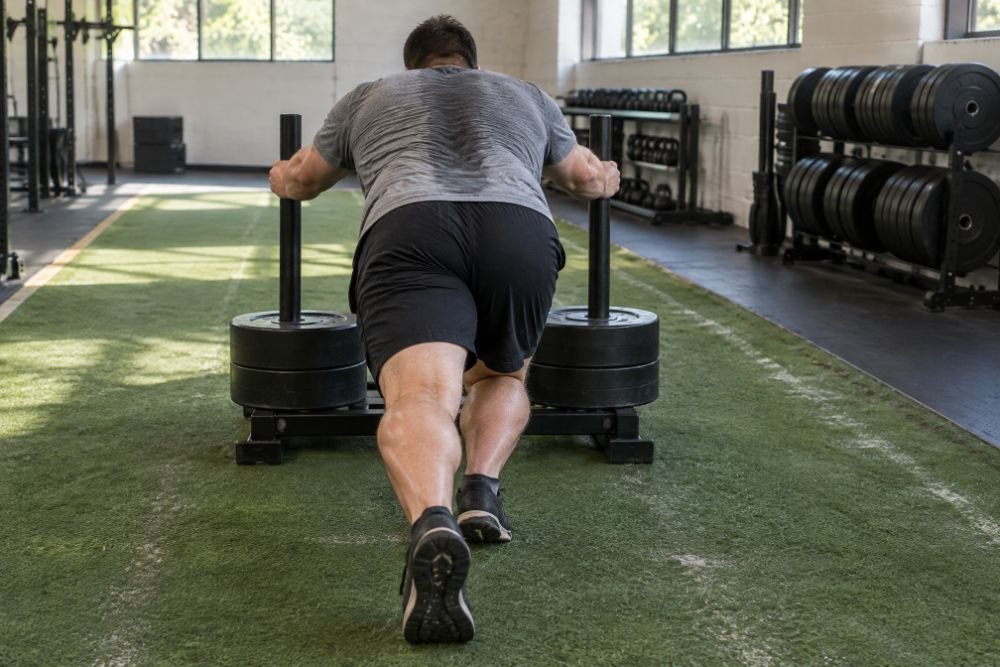
- Sled pushes and drags. Almost no eccentric loading, which means almost no soreness, and it is conditioning that feels like training rather than punishment. If your gym has turf and a sled, this is the most under-used piece of equipment in the building.
- Carries. Load a pair of dumbbells or a trap bar and walk. Heart rate goes up, grip and trunk get worked, and it counts.
- The stairs at work, the walk to the shop, the dog. Not a consolation prize. The guidance is explicit that accumulated moderate activity counts, in bouts of any length.
A twelve-week ramp that does not blow up
The mistake is starting at the target. Start below it and let the number climb.
- Weeks 1–3: three sessions of 20 minutes. Incline walk, bike, whatever you will actually turn up for. Sixty minutes a week, which is 40% of the target and infinitely more than nothing.
- Weeks 4–6: three sessions of 30. Ninety minutes.
- Weeks 7–9: four sessions of 30, or three of 40. One session goes harder — intervals on the bike or the rower, a minute on and two minutes easy, eight rounds.
- Weeks 10–12: 150 minutes, split however suits your week. Now, if you want to run, add it: 60 seconds of jogging inside a 30-minute walk, twice a week, and build from there over months rather than weeks.
Notice that the strength work does not stop while this happens. Conditioning and lifting are not in competition at this dose; two sessions of each is a manageable four days.
Two things that make the whole thing easier
Shoes. A supportive, wide, cushioned trainer replaced every 500–800 km is not a luxury purchase for a heavier walker. Most of the foot and shin pain that ends walking programmes is a shoe that flattened out two hundred kilometres ago.
Chafing. Nobody writes about this and it stops more people than joint pain does. Longer compression shorts under everything, an anti-chafe balm, and a technical shirt rather than cotton. It is a five-minute fix for a problem that otherwise quietly ends the habit in week three.
What good looks like after a few months
Not a race time. A resting heart rate that has dropped, stairs that stopped registering, a warm-up that no longer feels like the hard part of the session, and the ability to do a hard set of squats without needing four minutes to recover. Those are the returns, and they arrive from a rower just as readily as from a road.
And if you never run a step, you have lost nothing that matters. The 150 minutes is the point. The mode is your business.
General information about exercise, not medical advice. If you have known heart disease, chest pain on exertion, uncontrolled blood pressure, or you have been inactive for a long time and have other risk factors, get cleared by a doctor before starting a conditioning programme — and stop and seek help for chest pain, unusual breathlessness, or dizziness during exercise.