Your Knees Are Not The Problem
Somewhere along the way, big men were handed a rule: protect your knees by not using them. It is the most confidently repeated piece of bad advice in fitness, and the research points almost exactly the other way.
Where the rule came from
The logic sounds airtight. Cartilage wears out. More weight means more force through the joint. More force means faster wear. Therefore a heavier person should keep load off their knees, and certainly should not add a barbell to the situation.
Every step of that reasoning is intuitive, and the conclusion is still wrong. Joints are not brake pads. Cartilage is living tissue that responds to load the way muscle and bone do: it adapts to what it is asked to do, and it degrades when it is asked to do nothing. The knee that has never been loaded is not a preserved knee. It is an unprepared one.
The running study that should have ended the argument
If load wore joints out on a simple dose-response curve, runners would be the worst-off people in any orthopaedic clinic. A 2017 systematic review and meta-analysis in the Journal of Orthopaedic & Sports Physical Therapy pooled 25 studies covering more than 125,000 people and looked at how common hip and knee osteoarthritis actually was.
Recreational runners came in at 3.5%. Sedentary non-runners came in at 10.2% — nearly three times as many. Competitive and elite runners, the ones logging enormous mileage for a living, came in at 13.3%.
Read that middle number again, because it is the one that matters here. The group with the most arthritis after the professionals was the group doing nothing. The curve is not a straight line from "no load" to "ruined". It is a U: too little is bad, an enormous professional dose is bad, and the broad middle where ordinary training lives is the best place on the graph.
Alentorn-Geli E, Samuelsson K, Musahl V, Green CL, Bhandari M, Karlsson J. The Association of Recreational and Competitive Running With Hip and Knee Osteoarthritis: A Systematic Review and Meta-analysis. J Orthop Sports Phys Ther. 2017;47(6):373–390. Read 4 September 2026.
What happens when knees that already hurt get trained
The stronger version of the objection is not about prevention. It is about the knee that already aches on stairs. Surely that knee should be left alone?
This has been studied directly and repeatedly, because it is one of the most common clinical questions in the world. A 2024 network meta-analysis in PLOS ONE compared three kinds of resistance training in people who already had knee osteoarthritis. All three improved pain and function. The best-performing variant reduced pain by a mean difference of 1.33 points and improved function by 12.24 points on the standard scales — not a rounding error, and better than most of what is available in a bottle.
The clinical guidelines have said the same thing for years. Exercise is not a risky extra for knee arthritis. It is the first-line treatment, ahead of the drugs.
Jiang Y, Tan Y, Cheng L, Wang J. Effects of three types of resistance training on knee osteoarthritis: A systematic review and network meta-analysis. PLOS ONE. 2024;19(12):e0309950. Read 4 September 2026.
So what actually hurts knees
Three things, none of which is "being heavy and squatting".
Doing nothing, for years
Quadriceps weakness is one of the most consistent findings in people with knee osteoarthritis. The muscle around a joint is part of how that joint manages force. Let it go and the joint takes a bigger share of everything, every day, forever — not just on the days you train.
A change in load with no ramp
Almost every training knee injury is a spike, not a total. Someone does nothing for four years, then plays two hours of basketball on a Saturday, and blames the basketball. It was not the basketball. It was the difference between four years and two hours. The same person adding twenty minutes of squats twice a week for two months would have been fine.
Positions your leverages do not allow
This one is real, and it is where being a bigger guy genuinely changes the answer. A deep, narrow-stance, upright squat is a position built around one set of proportions. If yours are different — long femurs, a big torso, limited ankle range — forcing that position loads your knee in a way it does not like, and it will tell you. That is not a reason to stop squatting. It is a reason to squat differently.
How to load a knee that has opinions
- Widen the stance and turn the toes out. More room for a bigger body to descend into, less demand on ankle range, and the knees track over the toes instead of fighting inward.
- Raise the heels. Lifting shoes or a small plate under each heel is the single fastest fix for the ankle range that limits most big lifters. It lets the hips drop without the torso folding forward.
- Use the box. Squatting to a bench or box gives a consistent depth and lets you own a range you can actually control, then lower it over months.
- Split the load across more days. Two sessions of moderate leg work beat one heroic session and five days of stiffness — and the CDC's floor of two muscle-strengthening days a week is a floor, not a ceiling.
- Add before you subtract. Leg press, leg extension, sled pushes, step-ups and cycling all load the quadriceps with a fraction of the balance demand. If barbell squats are not available yet, that is a sequencing problem, not a permanent state.
The difference between pain that is information and pain that is a stop sign
A useful working rule, and one used in the clinical trials that put arthritic knees under a barbell in the first place: discomfort during a set that settles within a day is acceptable. Pain that climbs through the session, pain that is worse the next morning than it was that evening, or pain that changes how you walk, is not. Swelling, locking, giving way and a knee that cannot straighten are not training feedback; they are reasons to be looked at.
Within that boundary, the honest position is that some ache while you build tolerance is normal and is not damage. People spend years avoiding a sensation that was never a warning, and lose the strength that would have made it go away.
The part that has nothing to do with cartilage
There is one more reason this advice does so much harm. "Protect your knees" is rarely just about knees. It is usually the polite version of a bigger message, delivered to big men constantly, that their body is fragile and the responsible thing is to do less with it.
You have been carrying your bodyweight up stairs and around a job for years. Your tendons, your skeleton and your postural muscles have already adapted to a load most people never handle. That is a training history, not a liability. The barbell is not asking your knees to do something unprecedented. It is asking them to do something structured, with a warm-up, in a rep range you chose.
What to do this week
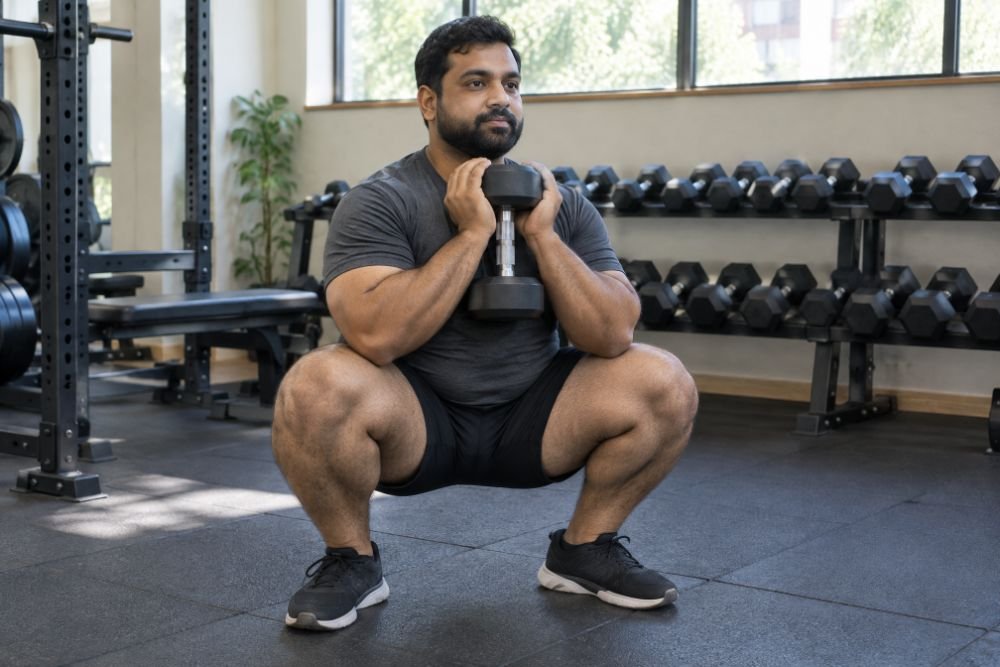
Pick one loaded knee movement you can do without limping tomorrow — a goblet squat to a box, a leg press, a step-up onto something low. Do three sets of eight, twice this week, and stop each set two reps short of grim. Add a small amount next week. Do that for two months and the knee that you were told to protect will be doing the protecting.
General information about strength training, not medical advice, and not a substitute for assessment of a specific knee. New swelling, locking, giving way, or pain that wakes you at night should be looked at by a clinician before you add load. If you have had a knee replacement or a recent injury or surgery, your surgeon's protocol outranks everything on this page.